Posts

Showing posts with the label Clinton

Northern Pacific Railroad Spur Track in Wallace, Montana

Image
I wasn't planning on posting today, but I accidentally happened upon a May 1903 USGS topographic map of Clinton tonight, so I decided to take a closer look at it and see if I could see the spur track mentioned in the Mickelsen papers . Lo and behold, the map shows one! The track wasn't very long at all (See blue arrow below). It definitely didn't reach the mining camps -- It didn't even reach Wallace Creek -- but there must have been enough activity from mining and logging that it was needed. The map, which is based on surveys from 1900, also shows the Betters/McQuarrie home (See green arrow). There are lots of other fun things to see on the full map, which you can access yourself at the USGS website .

Origins of Names of Stations and Townsites from Northern Pacific Railway Corporate Records

Image
I haven't yet been able to return to the Mansfield Library in Missoula, but a helpful employee in Archives and Special Collections saved me a trip. She took a look through the Northern Pacific Railway Company records I mentioned in a previous post and reported that she did not find any references to Wallace, Blossburg, Clinton, or McQuarrie within. She referred me to the Minnesota Historical Society (MNHS), which was next on my list anyway. MNHS will digitize records in their collection upon request for a small fee, so last month I ordered the scan of two folders listed in their finding aid as "Origins of names of stations and townsites." My order was delivered digitally today and I am going to share with you what I found. First, an attribution: Most of the pages appear to be part of a typewritten document titled: Northern Pacific Railway The Origin and Historic Significance of the Names of Towns and Stations Located on the Lines of the Railway A Record Compiled by John ...

Tough, Willing, and Able: Tales of a Montana Family

Image
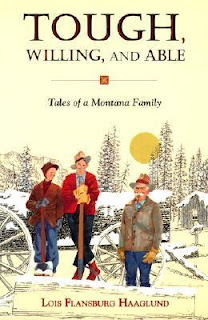
I visited the Lewis and Clark Library in Helena earlier this month. While there, I decided to see if they had anything in their collection that would be useful for my research. They did! The book, Tough, Willing, and Able by Lois Flansburg Haaglund "tells the story of the Flansburgs, a logging family in Clinton, Montana, whose combined courage sustains them through the hardships of the Great Depression and beyond." Not only did the library have this book in its collection, it was in circulation and it was on the shelf, so I checked it out. I'm pretty sure I had heard about this book before, but even when I had a copy of it in my hands at the Lewis & Clark Library, I didn't fully understand its potential relevance to my family history research. The Flansburg name was familiar to me, though, and since the book was about a logging family in Clinton, I figured it was worth a read, in case there was some useful information in it. I realized later why the Flansburg name...

Even in the 1930s, Clinton-Area Residents Were Confused About the Origin of Their Town’s Names

Image
I came across this article from the January 7, 1932 issue of The Missoulian today and thought it was worthy of a quick share: So, as to the origin of the name "Clinton," W.C. Peat, who was then secretary of the Missoula Chamber of Commerce, believed that Clinton was named after a surveyor on the crew that laid out the Northern Pacific Railroad. W.H. Beacom, who was Missoula's mayor at the time this article was written, recalled that Clinton was named after C.L. Clinton, an official of the Northern Pacific Railroad. Is a surveyor an official? Were Peat and Beacom in alignment, or are these two different NPRR employees named Clinton? F.G. Bond and Andrew Logan both provide a logical reason for why the town's name was changed from Wallace that aligns with my long-held belief, which is that there was confusion with Wallace, Idaho, another small, mining town 135 miles west on the route of the NPRR. Why Wallace, Idaho was able to keep its name when the Wallace Mining Distr...

Betters Homestead / Pine Grove House in Pineland Grove

Image
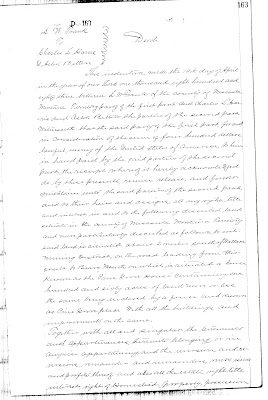
As I noted in a post from 2015 , Don Bert Omundson's 1961 thesis "Study of place names in Missoula County, Montana"  was a real breakthrough for my Clinton/Betters research. His thesis included some supplementary pages, labeled "Miscellaneous information from Missoula Courthouse records about some of the places and men mentioned in the following thesis." In those pages was information about property acquired by Austin Betters in 1883. In 2017, I traveled to the Missoula County Record Center and found the deed referenced by Omundson. That deed has since been digitized and is now available online at the Missoula County Clerk & Treasurer's website (See below). The quitclaim deed is dated April 19, 1883, and transfers the property from L.W. Frank to Charles L. Harris and Astin [sic] Betters for $400. Here is the description of the property: said land is situated about 2 miles south of Wallace Mining District, on the road leading from Missoula to Bears Mouth...

More Wallace/Clinton post office history

Image
In a previous post , I stated that a post office had existed in Clinton prior to 1892, it had simply changed its name. That may not be correct. In flipping through Roberta Carkeek Cheney's book, Names on the Face of Montana , I discovered that she also had an entry for Wallace, which says: Wallace (Missoula) was granted a post office in 1892 [ sic ] with Elias Bryan as postmaster. Postal records say the name was changed to Clinton in 1892 but actually, the postal business for this area was merely transferred to Clinton, which is nearby. Based on information contained in Montana Post Offices and Postmasters  by Dennis J. Lutz, and on the usps.gov website, I believe Cheney meant for that first date to be 1883. I don't know what Cheney's source is for the fact that the change from Wallace to Clinton in 1892 was more than a name change, but it makes sense. The town of Wallace was established by 1883 in Wallace Gulch (area circled in red), close to the mines, while Clinton ...

Still on the hunt for any period documentation that Clinton was once known as Betters' Station

Yesterday I did some old-fashioned research at the Bozeman Public Library. I flipped through some books that are not available in digital form online. One of those books was Names on the Face of Montana  by Roberta Carkeek Cheney, which the Montana Historical Society had pointed to as one of the sources for the fact that Clinton was once known as Betters' Station . Indeed, both the 1971 and 1984 versions of the book state essentially the same facts that appear in Montana Office of Tourism publications and the Montana Historical Society's  Montana Place Names book: CLINTON (Missoula) is an old mining and lumber town. Ore deposits were discovered in 1889 and the Charcoal Mine yielded thousands of dollars worth of lead and silver. The name Clinton was chosen that year in honor of Henry Clinton. Originally the place had been known as Betters' Station. It was started as a stage station on the Mullan Road in 1883 and named for Austin Betters, a homesteader. The Northern Pacific...

History of Clinton, Montana

One of the most comprehensive histories of the Clinton area that I have found online is actually from the Montana Department of Environmental Quality. They have a historical narrative about the Clinton/Wallace mining district . 2023 Update: The original link was broken and I couldn't find the content on the current DEQ website, so the link now goes to an archive of the page.

Sometimes you discover more by not looking at your target

If you are interested in the history of the Hellgate Canyon, you will want to check out Two Rivers History . This website, and the physical Bonner Milltown History Center in the Bonner Post Office Building, are "devoted to exploring the rich history found at the confluence of the Clark Fork and Blackfoot Rivers and neighboring communities of Bonner, Milltown, Piltzville, Pine Grove, and West Riverside." Although Clinton is not included in that list, the fact that it is a mere 13 miles away, and sits on the same river and railways, means that it shares a similar history, and I think a lot can be learned about what was going on in Clinton at any given time by examining what was going on in Bonner-Milltown. In particular, you will want to read about The Great Flood of 1908 , the Northern Pacific Railroad , and the Milwaukee Railroad . Two Rivers History was instrumental in a breakthrough in my research of the Betters. I had seen a  September 23, 2012 article in the  The Miss...

What kind of station was Betters' Station?

Do you ever receive a response to an email you sent so long ago that you forgot that you sent it? Earlier this week I had that experience, when the Montana Historical Society Research Center responded to the email inquiry I sent to them back in March.  In the book,  Montana Place Names, published by the Montana Historical Society, it says "When it was established in 1883 as a stage stop and post office on the Mullan Road, Clinton was known as Betters' Station, after settler Austin Betters." In all of my research, I have yet to come across any mention of Betters' Station, or find any existence of a stage station run by the Betters in old Montana maps, history books, and land records. So I emailed MHS to see if they could provide me with the original source of their information. Here is their response: As far as I can determine, the info came from two sources---1) similar information is in "Names on the Face of Montana," by Roberta Cheney, 1984.  2) ...
The old mining and lumber town of Clinton, Montana was originally known as Betters' Station. According to the Montana Office of Tourism website at the time of this post, "It was started as a stage station on the Mullan Road in 1883 and named for Austin Betters, a homesteader." Austin Betters was my great-great-grandfather. Since moving to Montana in 2008, I have taken the opportunity to more deeply research this branch of my family tree. Up to this point, most of my findings have been cataloged on ancestry.com or in my own private files, but genealogy is something that is best done when everyone shares openly, and I have become increasingly displeased with Ancestry's paywalls and content restrictions. I understand that they are a business that has to make money, and digitizing and storing all of that information is not cheap, but millions of individuals have shared content with Ancestry without being compensated, and now Ancestry is monetizing that. Anyway, I hop...